


What Is a Mechanical Seal? Structure, Working Principle & Selection Guide
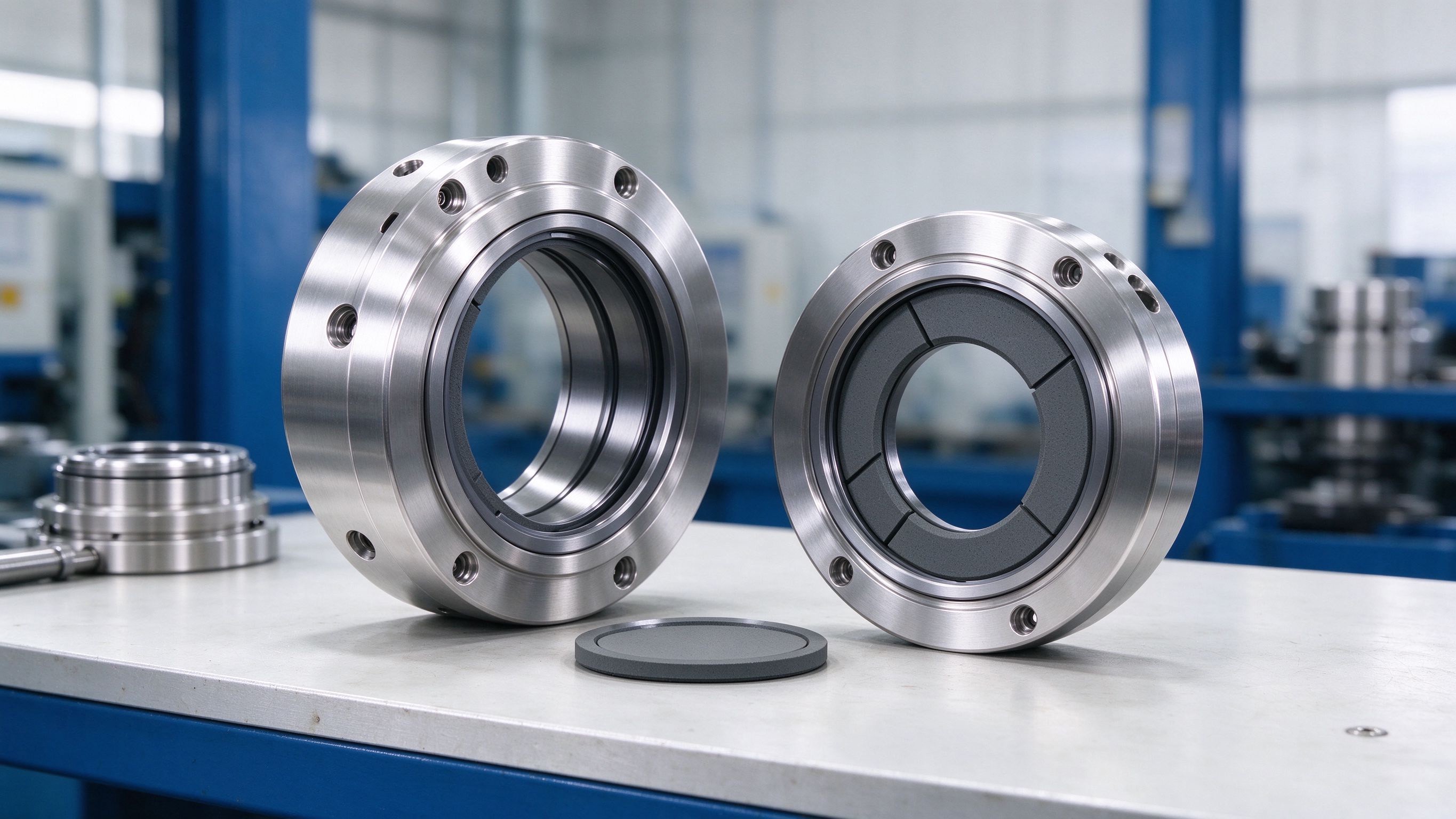
What Is a Mechanical Seal? Structure, Working Principle & Selection Guide
Leakage control on rotating fluid equipment is a long-standing challenge across the chemical, oil & gas, and water treatment sectors. Traditional packing seals suffer from rapid wear, high leakage rates and poor containment of emissions. As environmental regulations and continuous-production requirements tighten, mechanical seals have become the standard shaft-end sealing solution for pumps, agitated vessels and compressors — isolating process media from the atmosphere and reducing both product loss and safety risks.
1. Definition & Working Principle
A mechanical seal — also called an end-face seal — is a precision assembly that forms a dynamic barrier using two flat faces perpendicular to the rotating shaft. It does not operate on dry friction contact. Instead, under combined hydraulic pressure and spring force, a micro-scale fluid film is maintained between the rotating and stationary faces.
This thin film provides lubrication and heat dissipation while keeping leakage at an extremely low rate — which is the fundamental difference from static gasket seals. A small amount of medium is intentionally allowed to pass through the film; forcing true zero leakage would cause dry running and face burn-out.
2. Standard Mechanical Seal Assembly
A complete mechanical seal assembly consists of six core components:
- Rotating seal face — rotates with the shaft; the moving side of the friction pair, responsible for dynamic sealing.
- Stationary seal face — mounted in the pump casing or seal chamber; mates precisely with the rotating face.
- Loading element — spring or metal bellows; compensates automatically for face wear and axial shaft movement.
- Secondary seals — usually elastomer or PTFE O-rings/gaskets; fill static gaps between faces and the shaft/housing.
- Shaft sleeve — sleeves over the shaft, protecting it from corrosion and wear and providing a precision mounting surface.
- Drive mechanism — drive pins, set screws or key; ensures the rotating face turns in sync with the shaft without slip.
3. Face Material Pairing
Material selection for the friction pair is the most critical design decision, directly determining seal life and suitable service conditions. End-face flatness and surface roughness must be controlled at the micrometer level — a tiny deviation will break down the fluid film.
4. Key Factors Affecting Seal Life
Mechanical seal failure is rarely a single cause — it results from the interaction of service conditions, installation accuracy and maintenance. The most common failure triggers are:
(1) Abrasive particle scoring of the faces — the most frequent failure mode. Hard particles entering the friction pair create grooves that destroy the fluid film.
(2) Thermal shock and cracking — local overheating or rapid temperature swings cause elastomer hardening and radial cracking on seal faces.
(3) Misalignment and missing flush plans — excessive shaft runout, blocked flush lines or inadequate cooling all accelerate overheating and shorten service life.
5. How to Choose a Seal Supplier
When evaluating suppliers, verify the following three items rather than simply comparing price:
- Proven application references — same industry, same medium, same pressure/temperature range.
- Material certifications — face materials, bellows alloy and elastomer compound numbers must be traceable.
- Standardized test records — factory hydrostatic test, running test and leakage rate inspection on every unit.
Established manufacturers can supply supporting flush, quench and cooling systems, and offer cartridge seal solutions for slurry or flammable media — greatly reducing on-site assembly errors.
6. Main Application Industries
Mechanical seals are used across most process industries, with different priorities in each sector:
- Petroleum refining — feed pumps, reflux pumps; focus on low emission, explosion-proof and high temperature resistance.
- Fine chemical — reactors, agitators; focus on chemical resistance and solvent compatibility.
- Municipal water — sewage pumps, water transfer pumps; focus on solids tolerance and long service life.
- Food & pharma — sanitary-grade agitators; focus on crevice-free design and cleanability (CIP/SIP).
7. Industry Trends
The mechanical seal industry is moving in three clear directions:
Longer service life — hydrodynamic groove faces and corrosion-resistant composite coatings are becoming standard, optimizing film formation to reduce wear.
Lower emissions — standards such as API 682 continue to tighten leakage limits; dual and tandem seal configurations are increasingly specified.
Condition monitoring — smart seal units with integrated temperature and vibration sensors enable failure prediction, shifting maintenance from reactive to predictive.
FAQ
Related Posts
CONTACT US

First class quality service and professional after-sales team.
Get in Touch
*We respect your confidentiality and all information are protected.